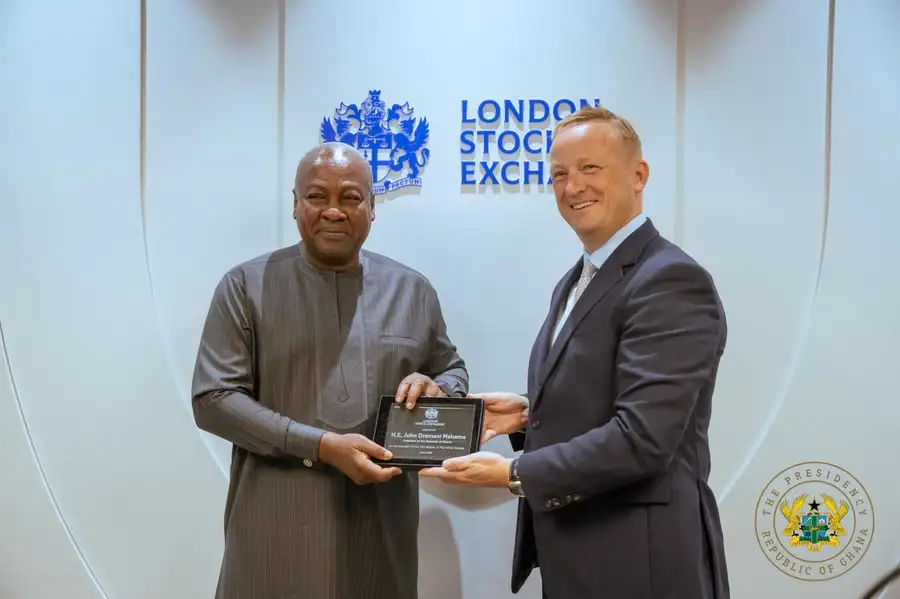
President Mahama Rings London Stock Exchange Bell as Ghana’s Market Confidence Rises
Ghana’s capital market is drawing fresh attention from global investors as improving economic indicators and a strong rally on the Ghana Stock Exchange point to renewed confidence in the country’s recovery.
President John Dramani Mahama has described the turnaround as a major sign that Ghana is regaining its place in international finance, following years of subdued market activity and economic uncertainty.
Speaking during a visit to the United Kingdom, where he rang the opening bell at the London Stock Exchange, President Mahama said the occasion marked an important milestone for Ghana and reflected the country’s rising visibility in global financial markets.
According to him, the Ghana Stock Exchange is experiencing what he described as a “renaissance,” driven by stronger investor appetite, new listings and improving macroeconomic conditions.
He noted that as of May 2026, the GSE Composite Index had recorded a return of 63.4 percent, making it the second-best performing equity market in the world.
The performance, he said, showed that Ghana’s capital market was recovering strongly after remaining largely inactive for about seven years.
“The GSE is in a renaissance. As of May 2026, the GSE Composite Index returned 63.4 percent, ranking second among the world’s equity markets. After seven years of dormancy, our primary market has revived,” President Mahama stated.
He also pointed to renewed activity on the primary market, highlighting three major Initial Public Offerings that have helped restore momentum to the exchange.
These include First Atlantic Bank PLC, Zen Petroleum and the upcoming listing of Kasapreko PLC within six months. Together, the IPOs are expected to raise about GH¢2 billion, which President Mahama said was a strong indication of investor confidence in Ghana’s economy and capital market.
Beyond the stock market, the President said Ghana’s broader economic indicators had also improved significantly since he assumed office in January 2025.
He recalled that the economy was facing major challenges at the time, including high inflation, weak confidence and pressure on businesses and investors. However, he said decisive policy actions had helped stabilise the economy and restore optimism.
According to President Mahama, inflation has dropped sharply from 54.1 percent to 3.4 percent, while the Ghana cedi has stabilised and interest rates have continued to decline.
He said these developments were helping to create a more predictable business environment, making it easier for companies to plan, invest and expand.
“These achievements are creating a predictable environment in which businesses can thrive,” he said.
President Mahama used the platform to assure both local and foreign investors that Ghana remains open for business. He said the country was stable, growing and ready to welcome investors looking for opportunities in Africa.
“Ghana is stable, Ghana is growing, and this is the time to join us on this journey of opportunity and shared success,” he added.
For investors, Ghana’s strong stock market performance is important because it shows renewed confidence in listed companies and the broader economy. A 63.4 percent return on the GSE Composite Index as of May 2026 suggests that investors who entered the market early have benefited from significant capital gains.
The revival of the IPO market is also a major development. For nearly seven years, Ghana’s primary market had been relatively quiet, limiting opportunities for investors to participate in new listings. The emergence of First Atlantic Bank PLC, Zen Petroleum and Kasapreko PLC signals that more companies may now be willing to raise capital through the stock exchange.
The expected GH¢2 billion from these IPOs also matters because it shows that the market is beginning to play a stronger role in financing business growth. This could create more opportunities for investors, improve market liquidity and deepen Ghana’s capital market.
However, investors should also be cautious. A fast-rising market can create excitement, but it can also lead to overvaluation if share prices move ahead of company fundamentals. Investors should pay attention to earnings, dividends, debt levels, industry performance and the long-term prospects of companies before buying.
The fall in inflation from 54.1 percent to 3.4 percent, a more stable cedi and declining interest rates could support stronger business performance if the trend continues. Lower inflation can protect consumer purchasing power, while lower interest rates may reduce borrowing costs for companies and make equities more attractive compared to fixed-income investments.
Overall, the message is that Ghana’s capital market is becoming active again. For long-term investors, this could be a period of opportunity, but it also calls for careful research, disciplined investing and a focus on quality companies rather than market hype.
Ghana’s renewed visibility at the London Stock Exchange sends a clear signal: the country wants to attract capital, deepen its financial markets and position itself as one of Africa’s promising investment destinations.