NIB Returns to Profit of GH¢343.9 million After Years of Financial Struggles
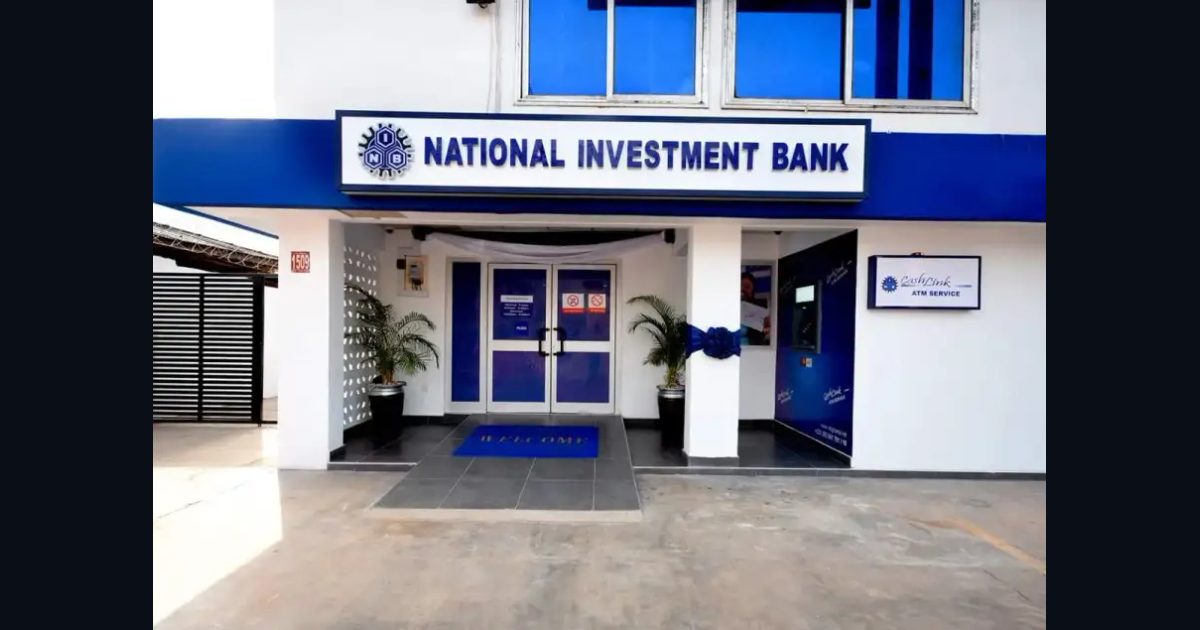
The National Investment Bank (NIB) appears to be finding its feet again after years of financial pressure, heavy loan impairments and regulatory restrictions that nearly pushed the state-owned lender into deeper distress.
The bank ended the 2025 financial year with a profit after tax of GH¢343.9 million, marking a major turnaround from the difficult years that followed the Domestic Debt Exchange Programme and the collapse in parts of its loan portfolio.
Managing Director of NIB, Chief Doli-Wura Zakaria, said the bank’s latest performance showed that the recovery was not a one-off improvement but part of a sustained turnaround.
“As at the close of the 2025 financial year, the figures have turned around, a sustained turnaround,” he told financial journalists last Tuesday.
According to him, NIB closed 2025 with total equity of GH¢1.55 billion, supported by GH¢3.43 billion in committed capital from the government, which owns 93% of the bank.
The bank also recorded strong growth in key income lines. Operating income rose by more than 135%, while net interest income increased by 212%. Overall growth for the year stood at 58%.
Mr Zakaria said the recovery momentum had continued into the first quarter of 2026 and expressed confidence that the bank would maintain the same direction through the rest of the year.
“The story is not going to change but remain the same for the second, third and fourth quarters,” he said.
The latest numbers represent a sharp change in NIB’s financial position. In previous years, the bank was struggling with negative capital adequacy, a large retained deficit and weak profitability.
Mr Zakaria said the bank’s capital adequacy had once fallen to negative 46.96%, while profit at the time was only GH¢2.7 million. Its retained deficit had also exceeded GH¢2 billion.
“This was not just rough years of a bank, but it was totally collapsing slowly,” he said.
NIB’s balance sheet also expanded significantly. Total assets increased to GH¢12.22 billion in 2025, compared with GH¢5.84 billion in 2024 and GH¢2.95 billion in 2022.
Customer deposits also rose sharply from GH¢6.47 billion in 2024 to GH¢10.20 billion in 2025, showing renewed confidence from depositors and corporate clients.
Loans and advances increased from GH¢670 million to GH¢730 million over the same period.
The bank’s interest income rose from GH¢720 million in 2024 to GH¢1.23 billion in 2025, while non-interest income increased from GH¢170 million to GH¢250 million.
This helped lift profit after tax to GH¢343.9 million, compared with about GH¢3 million in 2024. In 2022 and 2023, NIB had recorded losses of GH¢613 million and GH¢57 million respectively.
A major part of NIB’s past difficulties came from its exposure to the construction sector. The bank had about 42% of its loan book tied to construction-related lending.
When government payments to many contractors delayed, despite the contractors having interim payment certificates, several loans became non-performing. This placed pressure on the bank’s balance sheet and contributed to large impairments and provisions.
The Domestic Debt Exchange Programme also worsened the bank’s position, pushing it into insolvency in 2022.
As part of the recovery process, the Bank of Ghana had previously restricted NIB from granting new credit. That restriction was lifted last year, allowing the bank to resume lending.
Chief Finance Officer of NIB, Mohamed Gausu, said the bank’s return to profitability was driven by balance sheet growth, improved revenue generation and renewed confidence from major customers.
He said many corporate clients and large depositors had returned to the bank because of the visible turnaround.
Mr Gausu added that the lifting of the lending restriction had allowed NIB to explore new lending opportunities to match its enlarged deposit base.
“For instance, we have room to take on large single obligor transactions,” he said.
He disclosed that in the first quarter of 2026 alone, the bank had issued about half a billion cedis in loans, mainly in low-risk areas.
NIB has also taken steps to reduce its non-performing loans. Its NPL ratio declined from 76% in 2024 to 69.7% in 2025.
Although still high, the reduction reflects the bank’s aggressive loan recovery strategy, negotiated settlements and efforts to clean up its loan book.
Looking ahead, NIB says it is pursuing a three-year growth strategy built around five main pillars.
These include meeting regulatory capital adequacy requirements, aggressively mobilising low-cost deposits, investing in digital transformation, improving operational efficiency and strengthening staff performance and service quality.
Chief Treasury Officer, Osman Soale Atchulo, said the bank’s priorities for 2026 include rolling out a new core banking platform, redesigning credit and operational workflows, cutting unnecessary costs and renegotiating vendor contracts.
For investors and market watchers, NIB’s recovery is important because it shows how government-backed recapitalisation, improved governance and tighter risk controls can help restore confidence in a struggling financial institution.
However, the bank’s high non-performing loan ratio remains a key risk to watch. The turnaround is encouraging, but sustaining profitability will depend on whether NIB can continue growing deposits, manage credit risk properly and avoid repeating the lending weaknesses that hurt the bank in previous years.