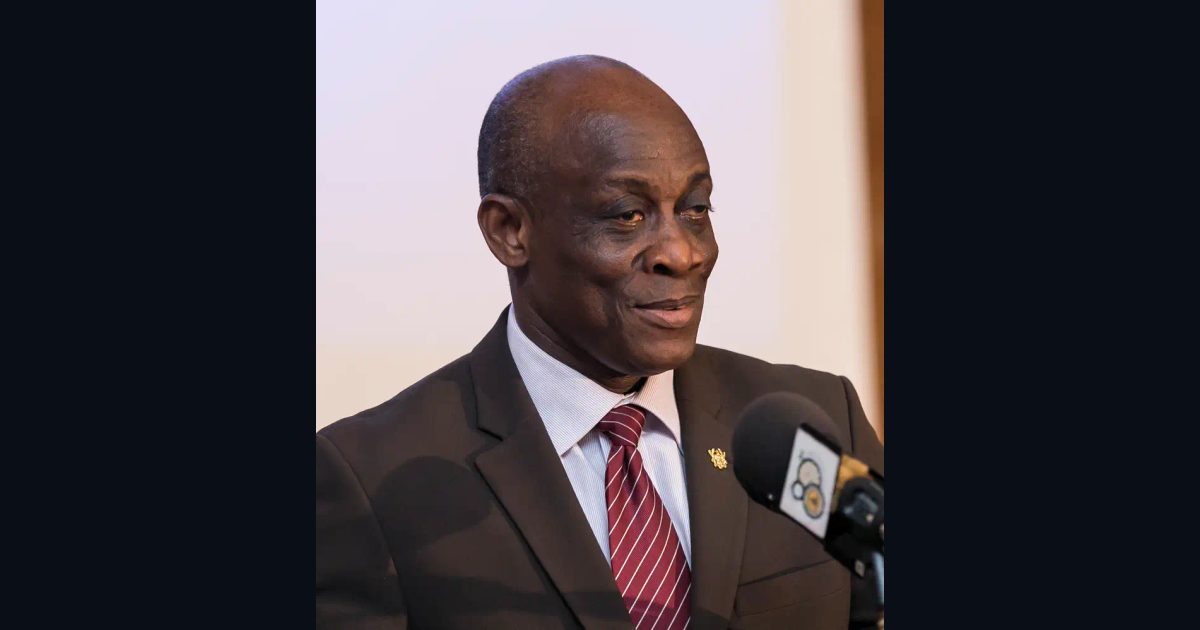
Government committed to restoring Bank of Ghana’s financial strength – Seth Terkper
Economic Advisor to President John Mahama, Seth Terkper, has reaffirmed the government’s commitment to maintaining fiscal discipline as part of efforts to restore the financial health of the Bank of Ghana.
Speaking on PM Express Business Edition with host George Wiafe on May 7, 2026, Mr Terkper said the government recognises the importance of having a strong and stable central bank capable of effectively carrying out its mandate.
According to him, the government’s recent efforts to improve Ghana’s credit ratings, strengthen foreign reserves and stabilise the cedi demonstrate its broader commitment to protecting the economy and supporting the central bank.
“If the government found it critical to work hard to improve our ratings and boost reserves to stabilise the currency, then it stands fairly to reason that this government will do everything to help restore the balance sheet of the Bank of Ghana,” he said.
Mr Terkper also urged the public to consider the difficult economic conditions the country has faced in recent years and the role the central bank has played in helping stabilise the economy.
His comments come after the Bank of Ghana released its 2025 audited financial statements, which showed that the central bank recorded an operating loss of GH¢15.6 billion in 2025, compared to GH¢9.4 billion in 2024.
The report also showed that the bank’s negative equity position worsened from GH¢58.62 billion to GH¢93.82 billion during the period.
Despite the losses, the central bank’s total assets increased from GH¢215 billion in 2024 to GH¢237 billion in 2025. Total liabilities also rose significantly from GH¢276 billion to GH¢333 billion.
The sharp increase in losses was largely linked to the cost of monetary policy operations aimed at controlling inflation and stabilising the economy.
According to the financial statements, Open Market Operations rose by about 95% to GH¢16.7 billion, while sterilisation liabilities to commercial banks increased by 186% to GH¢93.6 billion. Money market liabilities also more than doubled to GH¢93.8 billion.
The Bank of Ghana further explained that the Domestic Debt Exchange Programme affected returns on government securities, causing a major decline in interest income. The bank estimated forgone income for 2025 at more than GH¢12 billion.
The central bank has recently faced criticism, particularly from the Minority in Parliament, over the pace of its liquidity mop-up operations intended to reduce inflation.
However, Mr Terkper defended the measures, insisting that the situation required firm action.
He noted that some countries that adopted gradual approaches in similar situations did not achieve the desired results, adding that Ghana’s strategy was necessary under the circumstances.
On recapitalisation efforts, the Finance Ministry has already outlined plans under the Bank of Ghana Amendment Act 1158 to strengthen the central bank’s capital base and improve its financial resilience.
As part of the process, the Ministry of Finance signed a Memorandum of Understanding with the Bank of Ghana on January 6, 2025, which took effect the following day.
The agreement provides a framework for how the government intends to help reverse the bank’s negative equity position.
Under the arrangement, the recapitalisation plan is expected to restore the bank’s total equity to at least the authorised capital level by December 31, 2032.
Mr Terkper said the government remains fully committed to the agreement and rejected suggestions that the timeline for recapitalising the Bank of Ghana should be reviewed despite the growing operating losses.