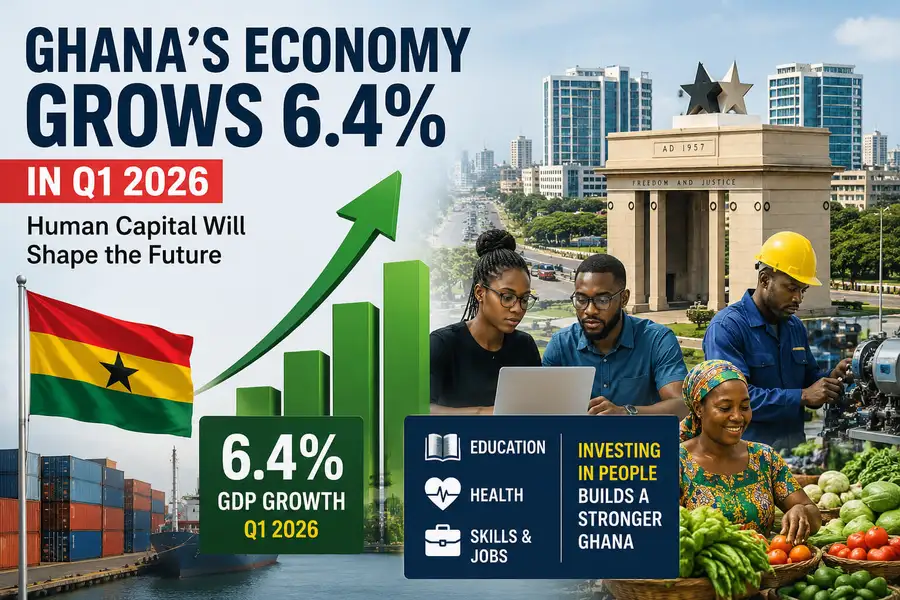
Ghana’s Economy Expands 6.4% in Q1 2026, Signalling Strong Recovery
Ghana's economy maintained its upward trajectory in the first quarter of 2026, expanding by 6.4% compared to the same period last year. The latest figures from the Ghana Statistical Service underscore the country's continued economic recovery, driven by strong performances across key sectors despite persistent global headwinds, tighter financial conditions, and ongoing domestic economic challenges.
While the growth numbers are encouraging, they also raise an important question: Can Ghana sustain this momentum without making significant investments in its people?
The latest GDP data shows that growth was broad-based, with both the oil and non-oil sectors contributing to the expansion. The services sector remained the largest driver of economic activity, supported by strong performances in information and communication technology (ICT), transport and storage, trade, and other service-related industries. The industrial sector also gained momentum, benefiting from increased activity in mining, quarrying, and the oil and gas industry.
Services alone accounted for nearly half of Ghana’s overall GDP growth during the period, reinforcing their importance to the economy. However, economists argue that while services-led growth is welcome, it must be accompanied by stronger development in manufacturing, agro-processing, industrial production, and export-oriented industries if the country is to achieve long-term transformation.
Economic growth figures often provide a snapshot of how much an economy is expanding, but they do not always reflect whether citizens are experiencing better living conditions, improved employment opportunities, or rising productivity. A country can record strong GDP growth while still struggling with unemployment, skills shortages, low productivity, and limited opportunities for social mobility.
This is where the issue of human capital becomes increasingly important.
Human capital refers to the knowledge, skills, health, and abilities that enable people to contribute productively to the economy. It is increasingly viewed as one of the most important determinants of a country's long-term competitiveness and economic success.
The importance of this issue was recently highlighted by the World Bank’s Human Capital Index Plus (HCI+), a tool designed to measure how effectively countries are preparing their populations for productive futures. The index assesses factors such as health, education, nutrition, employment prospects, and workforce productivity.
According to the World Bank, Ghana currently has an HCI+ score of 153 out of 325. While this places the country above the Sub-Saharan African average of 126, it remains roughly in line with the average for lower-middle-income economies. The figures suggest that Ghana has made notable progress in areas such as education and healthcare, but there is still significant room for improvement.
The challenge is particularly relevant as Ghana looks beyond traditional growth drivers such as mining, oil, and agriculture.
The rapid growth of the ICT sector offers a clear example. Technology has the potential to become one of the country's most important economic engines, but its success will depend largely on whether Ghana can produce enough skilled professionals in areas such as software development, artificial intelligence, cybersecurity, data analytics, digital finance, and business process outsourcing.
Without a workforce equipped with these skills, the country risks missing out on some of the most valuable opportunities emerging from the digital economy.
The same applies to industrial development. Moving beyond raw material exports and basic production will require a larger pool of engineers, technicians, logistics specialists, quality control professionals, financial experts, and entrepreneurs capable of supporting value-added industries.
Education therefore remains central to Ghana’s development agenda.
Although initiatives such as Free Senior High School have significantly expanded access to education, experts believe the focus must now shift toward improving quality and relevance. Beyond simply increasing enrolment, students need stronger literacy, numeracy, digital, technical, and problem-solving skills that align with the demands of a rapidly changing labour market.
Technical and vocational education and training (TVET) is also expected to play a critical role. Expanding apprenticeship programmes, technical training, and industry partnerships could help bridge the gap between classroom learning and workplace requirements while supporting sectors such as manufacturing, construction, agro-processing, logistics, and modern services.
Healthcare is another key component of human capital development. A healthier population is generally more productive, learns more effectively, and contributes more meaningfully to economic growth. Investments in maternal healthcare, child nutrition, preventive medicine, mental health services, and broader healthcare access are therefore increasingly viewed as economic investments rather than simply social expenditures.
Job creation remains equally important.
For growth to have a meaningful impact on living standards, it must generate sustainable and productive employment opportunities. If economic expansion continues while most workers remain trapped in low-income informal jobs, many of the benefits of growth will fail to reach ordinary households.
This challenge is especially significant given Ghana’s youthful population. Young people represent one of the country's greatest economic assets, but only if they have access to quality education, relevant skills, healthcare, and meaningful employment opportunities.
Ultimately, the latest GDP figures provide reasons for optimism. The economy is expanding, businesses are recovering, and key sectors are showing renewed strength. However, sustaining that progress will require more than strong growth numbers.
Experts argue that Ghana must use this period of economic recovery to deepen investments in human capital and ensure that growth translates into higher productivity, better jobs, and improved living standards.
Three priorities stand out. First, improving learning outcomes through better teacher training, stronger foundational education, and expanded digital and technical skills programmes. Second, increasing investment in healthcare and nutrition, particularly for mothers and children. Third, creating stronger links between education and employment through apprenticeships, industry partnerships, and support for small and medium-sized enterprises.
Ghana’s growth story remains promising. But the country's long-term success will depend not only on the size of its economy, but on the quality, skills, health, and productivity of its people.
Data references: Ghana Statistical Service Q1 2026 GDP release; World Bank Human Capital Index Plus country profile for Ghana.