Ecobank Lists US$450 Million Nature Bond on London Stock Exchange
Ecobank Lists US$450 Million Sustainable Bond on London Stock Exchange
Ecobank has taken a major step in sustainable finance after listing a US$450 million Sustainable Agriculture and Natural Capital Bond on the London Stock Exchange.
The bond will allow Ecobank to raise money from investors and use it to support environmentally friendly projects across Africa. These projects will focus on sustainable agriculture, water infrastructure, food production and the protection of natural resources.
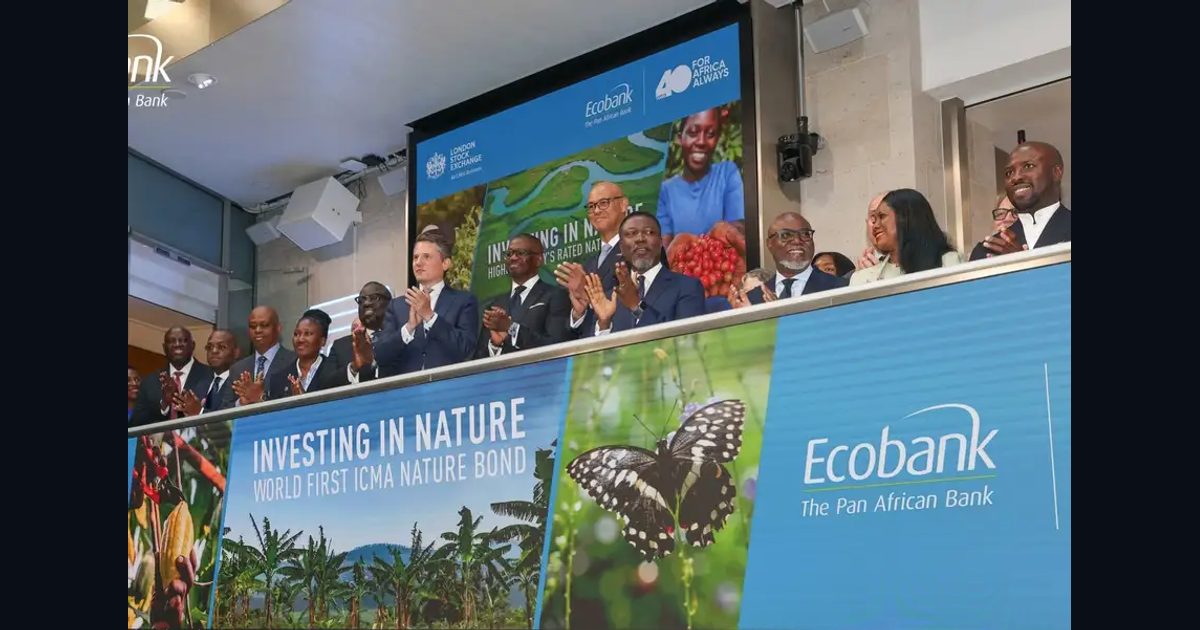
Ecobank marked the listing with a Market Open Ceremony at the London Stock Exchange, describing the transaction as an important achievement for African finance.
What makes the bond different?
The bond is the first commercial bank issued Nature Bond to receive formal recognition from the International Capital Market Association, also known as ICMA.
It is also the first use of proceeds green bond in the world to receive ICMA’s secondary Nature Bond label.
A use of proceeds green bond is a type of loan raised from investors. However, unlike a normal bond, the money must be used only for projects that provide environmental benefits.
Ecobank plans to use the funds to finance or refinance projects in 24 African countries where it operates.
The projects will mainly support sustainable farming, responsible food processing, clean water supply and sanitation.
The bank said it will give priority to countries that are important for biodiversity and nature conservation. The financing is also expected to strengthen Africa’s food production systems, agricultural supply chains and access to clean water.
Strong demand from investors
Investor interest in the bond was much stronger than Ecobank initially expected.
The bank originally planned to raise US$350 million. However, investors submitted orders worth more than US$1.36 billion.
This was nearly four times the amount Ecobank initially wanted to raise.
Because of the strong demand, Ecobank increased the final bond size to US$450 million.
The high level of investor interest also helped the bank reduce its borrowing cost by 50 basis points compared with its initial pricing guidance.
This means Ecobank was able to borrow the money at a slightly lower interest rate than it originally expected.
Credit rating agency Moody’s awarded the bond its highest Sustainability Quality Score of SQS1, which represents an excellent rating.
Investors from several regions participated
The bond attracted both African and international investors.
Investors in the United Kingdom and Europe received about 55 percent of the bond allocation, while African investors received 38 percent.
Investors from the Middle East received 3 percent, while investors from the United States and Asia received 2 percent each.
FMO, the Dutch entrepreneurial development bank, participated as the anchor investor.
The bond was structured as a Tier 2 capital instrument with a maturity period of 10.25 years. Ecobank has the option to repay the bond after 5.25 years.
Tier 2 capital instruments are commonly issued by banks to strengthen their long term capital position and improve their ability to absorb financial losses.
Ecobank marks listing in London
Senior Ecobank executives attended the Market Open Ceremony at the London Stock Exchange to celebrate the listing.
The delegation was led by Ecobank Board Chairman Papa Madiaw Ndiaye.
Other executives included Group Chief Executive Officer Jeremy Awori, Group Executive Director and Chief Financial Officer Ayo Adepoju, and Group Head of Sustainability Rachael A.O. Antwi.
Ecobank acted as the issuer, originator and sole sustainability structuring adviser for the transaction.
Standard Chartered Bank and Renaissance Capital Africa served as joint lead managers and joint bookrunners.
What this means for investors
The strong demand for the bond is a positive sign for Ecobank because it shows that international and African investors remain willing to provide long term funding to the bank.
The fact that orders reached more than US$1.36 billion also suggests that investors had confidence in Ecobank’s financial position, sustainability strategy and ability to repay the bond.
The transaction could strengthen Ecobank’s Tier 2 capital and provide additional funding to support lending and investment across its African markets.
The lower borrowing cost is another positive development. It means Ecobank may pay less interest than initially expected, which could help reduce financing expenses.
However, investors should remember that the bond increases Ecobank’s total financial obligations. The bank will be required to make interest payments and eventually repay investors, unless the bond is refinanced or called earlier.
For Ecobank Transnational Incorporated shareholders, the transaction is generally positive because it strengthens the bank’s capital base and improves access to international funding.
The long term benefit will depend on how effectively Ecobank uses the money, the quality of the projects financed and whether those projects generate reliable returns without increasing bad loans.
Overall, the bond listing strengthens Ecobank’s position as one of Africa’s leading financial institutions and shows that sustainable finance is becoming an increasingly important source of funding for African businesses.