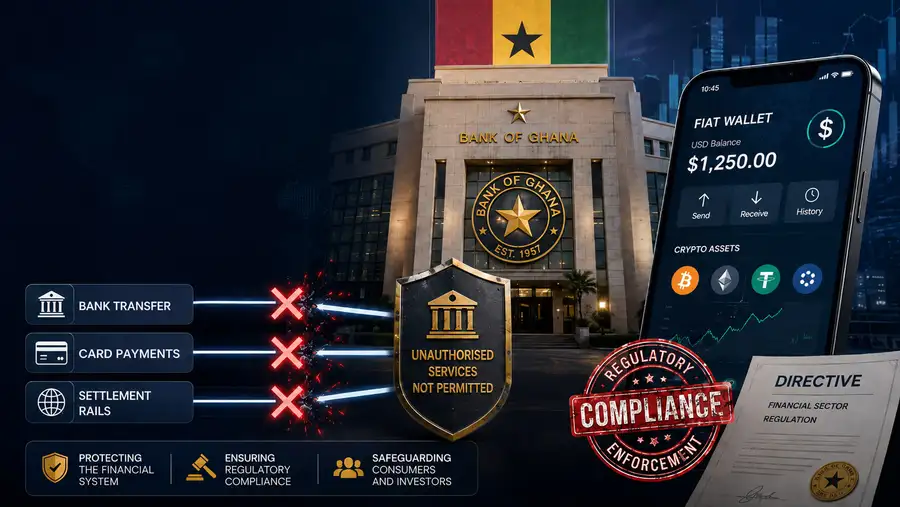
Bank of Ghana Orders Financial Institutions to Cut Ties with Unauthorized Crypto Fiat Wallets
The Bank of Ghana has moved to tighten control over crypto-linked financial activity in the country, directing banks, payment service providers, and other regulated financial institutions to immediately stop supporting unauthorized fiat currency wallet services operated by crypto platforms.
In a supervisory directive dated June 14, 2026, the central bank raised concerns about foreign currency wallet arrangements, particularly those denominated in U.S. dollars, being offered to users in Ghana by some crypto platforms without regulatory approval.
According to the Bank of Ghana, these wallet arrangements are often supported through local banking channels, payment cards, bank transfers, and other payment infrastructure provided by regulated financial institutions. The central bank said such activities fall under areas that require authorization, including the Payment Systems and Services Act, 2019 (Act 987), the Foreign Exchange Act, 2006 (Act 723), and other applicable regulatory requirements.
The BoG made it clear that the crypto platforms involved have not been authorized to provide these fiat currency wallet services in Ghana.
As a result, banks, specialized deposit-taking institutions, electronic money issuers, payment service providers, and other regulated financial institutions have been instructed to refrain from establishing, maintaining, or supporting any arrangement that enables the funding, operation, settlement, or customer access to unauthorized fiat currency wallets offered by crypto platforms.
The directive further stated that any institution currently providing banking, payment, card acquiring, settlement, or related services in support of such arrangements must take immediate steps to discontinue that support.
The Bank of Ghana also warned that institutions that fail to comply may face supervisory or enforcement action. Although the directive did not name specific crypto platforms, it emphasized that no such authorizations had been granted for the activities in question.
The move forms part of the central bank’s broader effort to regulate Ghana’s fast-growing digital asset space. While cryptocurrency activity continues to attract interest among users and investors, the BoG has maintained a cautious approach, focusing on consumer protection, financial stability, foreign exchange compliance, and the prevention of unauthorized financial activity.
The directive also comes at a time when the Bank of Ghana is developing a regulatory framework for Virtual Asset Service Providers. Institutions seeking guidance on the registration process have been directed to contact the central bank through vasp@bog.gov.gh.
The directive was signed by Aimeve Yda Quashie, Secretary of the Bank of Ghana.
Why this matters to investors
For investors, this directive is important because it signals that Ghana’s crypto and digital asset space is entering a more tightly regulated phase. Platforms offering dollar-denominated wallet services or crypto-related fiat accounts may face operational disruptions if they rely on banks and payment providers in Ghana to process deposits, withdrawals, or settlements.
This could affect users who hold funds in such wallets, especially if access to local payment channels is restricted. Investors using crypto platforms for dollar exposure, trading, savings, or transfers may need to pay closer attention to platform compliance, withdrawal options, and regulatory risk.
The directive also matters for banks, fintech companies, and payment service providers. Any institution connected to unauthorized crypto wallet arrangements now faces potential regulatory consequences, including sanctions, fines, or other enforcement actions if it fails to comply.
More broadly, the move shows that the Bank of Ghana is not banning digital assets outright, but it is making it clear that crypto platforms and related financial services must operate within approved regulatory channels. For long-term investors, this may eventually help create a safer and more transparent digital asset market in Ghana. However, in the short term, it could lead to tighter access, reduced liquidity, and uncertainty for users of affected crypto platforms.
The message from the central bank is clear: crypto-related innovation may continue, but only under proper authorization and supervision.